Play Tower Rush Now!
Home → Demo
Tower Rush Demo
What the Tower Rush demo gives you
Tower Rush is a crash game developed by Galaxsys in 2024, offering a theoretical return to player of 97.00% with a house edge of 3.00%. This high RTP stands in contrast to Rabbit Road by InOut Games, which operates at a lower 95.50% return rate for players over the long term. The difference means that consistent play on Tower Rush retains more capital compared to the competitor.
The maximum multiplier available in any single round reaches x100, capping the potential payout at 100x the stake amount. This limit is significantly lower than the max win of x1,000,000 found in Aviator by Spribe, which allows for massive outlier payouts. Players seeking extreme volatility might find the capped ceiling restrictive compared to the infinite growth potential of other crash titles.
Galaxsys implements a provably fair system using hash verification to ensure each tower floor result is random and transparent. This technical feature guarantees integrity without relying on third-party audits, distinguishing it from games like Chicken Road by InOut Games which may use different certification methods. The transparency applies to every round regardless of whether real money or demo credits are used.
Starting the demo without registration
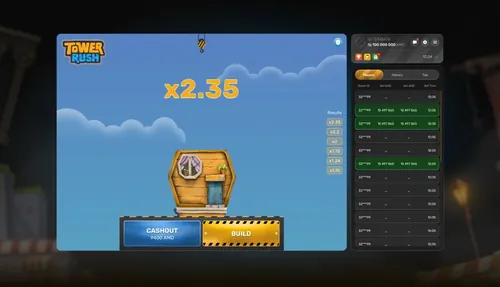
Accessing the Tower Rush demo requires no account creation or personal data submission, allowing immediate gameplay via a standard web browser. This frictionless entry contrasts with real-money play, where operators typically require KYC verification before processing withdrawals. The instant access model supports rapid testing of the three special bonus floor types: Frozen Floor, Temple Floor, and Triple Build.
The interface mirrors the real-money version exactly, including the auto cashout feature and the rising multiplier mechanic inherent to crash games. Unlike slots, there are no reels or paylines to align, removing visual clutter and focusing entirely on timing the exit before collapse. This streamlined design ensures that users evaluate the core mechanics without distraction from unnecessary graphical elements.
Players can test the Triple Build bonus floor repeatedly to understand its impact on cumulative odds without financial risk. Such unlimited practice sessions are impossible with real funds due to the finite balance available after deposit. The demo environment thus serves as a neutral training ground for mastering the specific timing required for optimal cashouts.
Demo balance and bet sizes
The demo mode provides an unlimited virtual balance that resets automatically upon page refresh or session timeout. This infinite credit supply differs fundamentally from the fixed starting balances often granted during welcome bonuses, such as the 100 free spins included with the 300% match up to €2,000. Unlimited funds allow for thorough stress-testing of betting strategies without the pressure of depleting a finite resource.
However, the proportional relationship between stake size and potential winnings remains identical, meaning a €1 bet yields 1/100th of the return of a €100 bet at any multiplier stage. This consistency ensures that strategic decisions made in demo mode translate directly to real-money performance.
Unlike Fish Road by InOut Games which offers a max win of x2,542,251.93, Tower Rush caps all returns at 100x the initial wager regardless of bet size. A €50 stake cannot exceed a €5,000 win, whereas a €0.50 stake is limited to €50. This rigid cap simplifies bankroll management but eliminates the possibility of life-changing payouts associated with higher-limit crash games.
What carries over to real money
No winnings accumulated in the Tower Rush demo convert to withdrawable cash, as the virtual credits hold no monetary value. This separation is standard across online gaming platforms, unlike some sweepstakes models where points might have redeemable worth. Players must transition to real-money accounts to experience actual financial gains or losses based on the 97.00% RTP.
The provably fair hash verification mechanism functions identically in both modes, ensuring that results generated during practice are statistically representative of live outcomes. This parity confirms that the RNG behavior observed in the demo accurately reflects the server-side logic used when real funds are wagered. Consequently, strategies tested against the Frozen Floor or Temple Floor bonuses remain valid under real conditions.
Technical features like the auto cashout function retain their precise millisecond execution timing when switched to real-money mode. This reliability is crucial for crash games where manual intervention often lags behind the rapid multiplier ascent. Users who optimize their auto-cashout thresholds in the demo can transfer these settings directly to their live accounts for consistent execution.
Browser requirements for the demo
Tower Rush runs on standard HTML5 technology, requiring only a modern web browser such as Chrome, Firefox, Safari, or Edge to function correctly. This universal compatibility ensures accessibility across desktop computers and mobile devices without installing dedicated applications. The absence of plugins or extensions reduces security risks and simplifies the user setup process significantly.
Mobile play support is integrated directly into the responsive design, allowing seamless transitions between landscape and portrait orientations on smartphones. This flexibility contrasts with older flash-based casino games that required specific device configurations or failed to load on iOS devices. The current implementation prioritizes touch-friendly controls essential for quick tapping during the critical cash-out phase.
Internet connectivity stability impacts the smoothness of the multiplier animation but does not affect the final provably fair result once the round concludes. Network latency might cause minor visual stuttering during rapid ascents, yet the underlying hash verification remains unaffected by connection quality. Players should maintain a stable data connection to ensure they do not miss the window to manually cash out before the tower collapses.
Tower Rush: key facts
| Parameter | Value |
|---|---|
| Game | Tower Rush |
| Studio | Galaxsys |
| Released | 2024 |
| RTP | 97.00% |
| House edge | 3.00% |
| Max win | 100x |
Reading the paytable in demo mode
The theoretical return to player for Tower Rush is 97.00%, a figure published by developer Galaxsys for their 2024 release. This percentage represents the long-term average payout over millions of rounds, establishing a house edge of exactly 3.00% for the casino operator. Players reviewing the interface should note that this RTP applies strictly to the crash mechanic rather than traditional reel-based mechanics found elsewhere.
Some operators configure alternative RTP settings ranging from 96.2% up to 97.6% depending on specific bonus floor conditions or regional regulations. This variation means the actual expected return might differ slightly from the standard 97.00% figure when real money is wagered. Users must verify which configuration is active before playing, as even a 0.8% difference impacts long-term bankroll management significantly.
The maximum multiplier available in any single round is capped at x100, limiting the potential win size regardless of stake amount. This cap ensures that the maximum possible win remains fixed at 100 times the initial bet placed by the user. Such limits define the risk profile clearly, contrasting with games like Chicken Dash which offers a much higher max win of 20,659x.
Testing bet levels safely
The welcome bonus structure offers a 300% match up to €2,000 alongside 100 free spins for new registrations. This promotional package requires careful bankroll allocation since the bonus funds are subject to specific wagering requirements before withdrawal. Players starting with the minimum deposit should calculate how these terms affect their ability to test low-stake strategies effectively.
Comparative analysis shows that other instant games like Mines and Dice also feature a 97.00% RTP, providing similar theoretical returns. However, Spribe's Plane Game introduces high volatility alongside its 97.00% return, creating a different risk dynamic compared to Tower Rush. Understanding these distinctions helps users select appropriate bet sizes based on their preferred variance level during testing sessions.
Spribe's Dice game allows adjustable volatility settings, offering players more control over risk than the fixed parameters of Tower Rush. This flexibility contrasts with the static nature of the tower-building mechanic where each floor increases cumulative odds predictably. Users comparing these options should consider whether adjustable risk or consistent progression better suits their testing objectives.
How many rounds make a fair test
A fair statistical evaluation of Tower Rush requires analyzing hundreds of thousands of rounds to approach the stated 97.00% RTP. Short-term sessions often deviate significantly from this mean due to the inherent randomness of the provably fair RNG system used by Galaxsys. Users relying on small sample sizes may draw incorrect conclusions about game performance or fairness based on temporary variance.
The provably fair mechanism utilizes hash verification to ensure transparency in every round outcome generated by the random number generator. This technical feature allows independent verification of results but does not influence the frequency of wins or the speed of tower collapse. Players should understand that cryptographic security guarantees integrity without altering the underlying mathematical expectations defined by the 3.00% house edge.
Other titles like Plinko share the 97.00% RTP figure but utilize different mechanics involving falling balls across pegged boards. TaDa Gaming's Chicken Dash features high volatility with a massive 20,659x max win potential, differing vastly from Tower Rush's x100 limit. These comparisons highlight why sample size matters when evaluating games with different payout structures and volatility profiles.
Session length and pacing
Each round in Tower Rush involves stacking floors until the tower collapses, with cash-out decisions made before the end occurs. This immediate resolution creates a faster pacing compared to slots that require multiple spins per session to trigger features. The rapid cycle allows players to complete many rounds quickly, potentially accelerating both wins and losses within a short timeframe.
The inclusion of special bonus floors such as Frozen Floor, Temple Floor, and Triple Build adds complexity to the pacing strategy. These elements can extend the duration of successful runs by providing additional multipliers or protective mechanisms against collapse. Users employing auto cashout features might experience different session lengths depending on how aggressively they set their target multipliers.
Contrasting with slower games, the instant nature of Tower Rush means session length is determined entirely by player decision speed. Unlike Spribe's Plane Game which has high volatility, Tower Rush offers a controlled risk environment through its building mechanic. This distinction affects how users allocate time, with many completing dozens of rounds in the time it takes to spin a slot machine once.
Common mistakes in free play
Misunderstanding the 97.00% RTP as a guarantee for individual sessions leads many players to expect consistent returns during short tests. This theoretical figure only applies over an extended period involving hundreds of thousands of rounds, not a few dozen attempts. New users often confuse this long-term average with short-term results, leading to unrealistic expectations about winning frequency in demo mode.
Overlooking the x100 maximum multiplier cap causes some players to chase unrealistically high payouts that the game simply cannot provide. Since the maximum win is limited to 100 times the bet, strategies focusing on extreme multipliers are mathematically doomed to fail. Recognizing this hard limit helps users adjust their cash-out targets to realistic levels aligned with the game's design constraints.
Ignoring the difference between Tower Rush and slots results in applying incorrect betting systems designed for reel-based games. Features like paylines and spinning reels do not exist here, making traditional slot strategies ineffective or misleading for this crash game. Users must adapt their approach to focus on timing cash-outs rather than predicting symbol combinations or line hits.
Demo versus real money differences
The Tower Rush game by Galaxsys operates with a theoretical return to player of 97.00 percent in real money mode, which establishes a house edge of exactly 3.00 percent over extended play sessions. This mathematical baseline defines the long-term expected loss for players using actual currency, contrasting sharply with the risk-free environment of the demo version where no financial stakes are involved. Players must recognize that this percentage applies only after hundreds of thousands of rounds, ensuring that short-term variance does not reflect the true statistical expectation.
Different operators may configure alternative RTP settings ranging from 96.2 percent up to 97.6 percent depending on their specific bonus floors and regional regulations, which directly impacts the potential returns in cash play. The maximum win cap remains fixed at 100 times the initial stake regardless of these configuration changes, capping the absolute payout potential for any single successful round. Understanding these variations helps players manage expectations regarding volatility and the likelihood of hitting the highest possible multiplier during their session.
Why results vary between sessions
Galaxsys utilizes a provably fair algorithm based on hash verification to ensure that each Tower Rush round is random and independent of previous outcomes or player actions. This technical foundation guarantees that the rising multiplier sequence cannot be predicted or manipulated, making every crash point entirely unpredictable for the participant. Consequently, session results will fluctuate significantly due to the inherent randomness of the RNG rather than any systematic pattern or bias in the game logic.
The maximum multiplier reaches x100, yet most rounds terminate far earlier due to the high volatility nature of this instant game format. A player might experience a series of quick collapses before finally achieving a significant win, illustrating how variance affects short-term bankroll management strategies. This statistical reality means that even with a favorable theoretical return, individual sessions can result in substantial losses before any profitable outcome occurs.
Using demo to learn the bonus round
The demo mode allows users to practice identifying the three special bonus floor types: Frozen Floor, Temple Floor, and Triple Build, without risking any actual funds. These unique mechanics alter the standard tower-building process by introducing specific multipliers or protective features that can extend the duration of a round. Mastering the timing required to cash out before a collapse becomes intuitive through repeated exposure in the risk-free simulation environment provided by the platform.
Switching from demo to cash play
Transitioning to real money requires activating the auto cashout feature to mitigate emotional decision-making during the rapid ascent of the multiplier in Tower Rush. This tool ensures that profits are secured automatically when a predetermined threshold is reached, preventing the common mistake of waiting too long for higher gains. The developer Galaxsys designed the interface to facilitate quick reactions, but automated systems provide a crucial safety net for inexperienced players entering the cash market.
When the demo is worth your time
The demo version proves valuable for understanding the mechanics behind the 300 percent welcome bonus up to 2,000 euros plus 100 free spins offered by new casinos. Players can simulate how the max win cap of 100x interacts with bonus wagering requirements before committing their own capital to the table. This preparatory step helps avoid confusion regarding eligible games and ensures that strategic decisions align with the specific terms attached to promotional offers.
DemoRTP & VolatilityHow to PlayAuto CashoutStrategyBonusesMobileDownload & AppMax WinSimilar GamesReviewFAQSitemap
Tower Rush 2026